







Small house, big getaway: How Europe's tiny houses are quietly redefining the holiday
From crowded resorts to a cabin in the woods
The slow drift away from the standard European holiday has been going on for some time, but it has accelerated since the pandemic. Sold-out beach resorts, queues at airport security, hotel breakfasts shared with three coach parties – none of it feels quite as restful as the brochure promised. Many British travellers are quietly opting out, looking instead for something smaller, slower and a little harder to find.
What they tend to be after is fairly specific. A place in the woods or by a lake. Good design, but nothing showy. Proper insulation and a real bed, not a damp groundsheet. Somewhere private enough that the only sound at six in the morning is birdsong, but close enough to a city or a station that the journey itself does not become the holiday's main event.
Tiny houses and design-led glamping cabins have grown to fill exactly this gap. They sit somewhere between camping and a boutique hotel – more comfortable than the former, more interesting than the latter, and almost always less crowded than either. Across Europe, small networks and individual hosts are putting up well-built cabins in fields, forests and on lake shores, and travellers have responded with a quiet enthusiasm that the wider industry is only just catching up with.
Two examples sit at opposite ends of the spectrum but make the same point. In Germany, RAUS has built a network of design cabins within reach of Berlin, Hamburg and Leipzig. In Poland, Bento Houses offers just two cabins, hidden in a forest about 25 minutes from the city of Warsaw. Different scales, very similar idea: leave the city, sleep in a small, well-made building, and let the surroundings do the work.
What makes a good tiny house stay?
Before booking anything, it helps to understand what separates a well-thought-through tiny house from a glorified shed.
The first thing to check is whether the cabin is genuinely all-season. A timber shell with a wood-burning stove looks lovely in the photographs, but a stay in late October needs proper insulation, reliable heating and double or triple glazing. Look for a real bathroom – not a chemical toilet behind a curtain – and a kitchen with at least a hob, a fridge and somewhere to sit and eat. The smallest cabins manage all of this in fewer than 20 square metres, which is part of the appeal.
Then there is the question of how the space is used. The best tiny houses tend to push the bed up against a large window, tuck storage into the walls, and use high ceilings to make a small room feel generous rather than cramped. Light is doing a lot of the heavy lifting. A well-designed cabin should feel like a quiet, edited room, not a caravan with nicer fabric.
Privacy and positioning matter just as much as the building itself. A cabin three metres from its neighbour and overlooking a car park is not the same product as one tucked into the trees with a view across a meadow. Check the photographs of the surroundings as carefully as those of the interior. If a host is shy about showing the wider site, there is usually a reason.
Finally, think about access. Some of the best tiny houses are deliberately remote, which is part of the charm – but check how you would get there without a car, how far the nearest food shop is, and whether you would be happy walking out of the door straight into a forest path. The point of these stays is to slow down. It helps if the practicalities have been worked out in advance.
Germany: design cabins and lake views with RAUS
RAUS, founded in Berlin in 2021 by three school friends, has become one of the most recognisable names in the European cabin scene. The model is straightforward: place small, contemporary cabins on privately owned rural land within a couple of hours of Germany's major cities, and let guests do almost nothing for a couple of days.
The cabins themselves are the work of Danish architect Sigurd Larsen, who has paired roughly 18 square metres of interior space with floor-to-ceiling windows and a deliberately dark, monochrome palette inside. The black-stained wood reduces reflections in the glass, which means the view – meadow, forest or lake – stays the focus, even with a bedside light on. A double bed is pushed up against the main window. Bathroom, kitchenette and storage are folded into a single inhabited wall. The rest of the space stays open, with a high ceiling that pulls in a surprising amount of light.
RAUS now has sites scattered across Germany. Some are single or twin-cabin set-ups for couples who want absolute quiet. Others are larger "lodges" with shared facilities. The Lodge am See, on the Elbe near Lenzen, is perhaps the most ambitious: 14 cabins arranged on a terraced slope down to the lake, with a shared sauna, a hot tub, an outdoor shower, paddleboards and bicycles. It is roughly 170 km from Berlin and about an hour and three-quarters from Hamburg – close enough for a long weekend, far enough that the city feels properly left behind.
For a quieter stop, Lodge Landsitz arranges four identical cabins among apple trees on the grounds of an old country estate, with a communal sauna and easy access to the surrounding nature park, including some of the region's largest beech forests. RAUS's smaller "double-site" locations – just two cabins, set far enough apart to avoid small talk but close enough to glimpse a neighbour's lit window through the leaves – tend to suit couples best.
The typical experience reads something like this: arrive in the late afternoon by car, find the cabin through an app-based check-in, light the wood-burning stove, watch the sun go down through the panoramic window, and spend the next day reading, swimming, walking and, if the location has one, alternating between sauna and lake. There is no reception, no breakfast buffet and no minibar. There is, generally, a fire pit, a kettle, and a great deal of silence.
Poland: Bento Houses, two cabins in the woods near Warsaw
A thousand kilometres east, Bento Houses operates on a different scale entirely. The site, in the village of Kąck in the Mazovia region, holds just two cabins, set on a fenced and quietly monitored patch of forest about 25 minutes by car from Warsaw. A city bus stops three minutes away, and Chopin Airport is well under an hour. For British travellers, this is significant: it makes a long weekend in a forest near a capital city a realistic proposition rather than a logistical puzzle.
The cabins are named after the Japanese lunchbox they take their inspiration from – small, ordered, complete. Each is around 17 square metres, fully heated, with a king-size bed, a wood-burning fireplace, air conditioning, a kitchenette with an induction hob and fridge, a shower room with a Swedish-style separation toilet, and a small terrace looking into the trees. Wi-Fi is fast enough for remote working, and there is an Aeropress, a Chemex and a filter machine on the side, which suggests a certain seriousness about coffee.
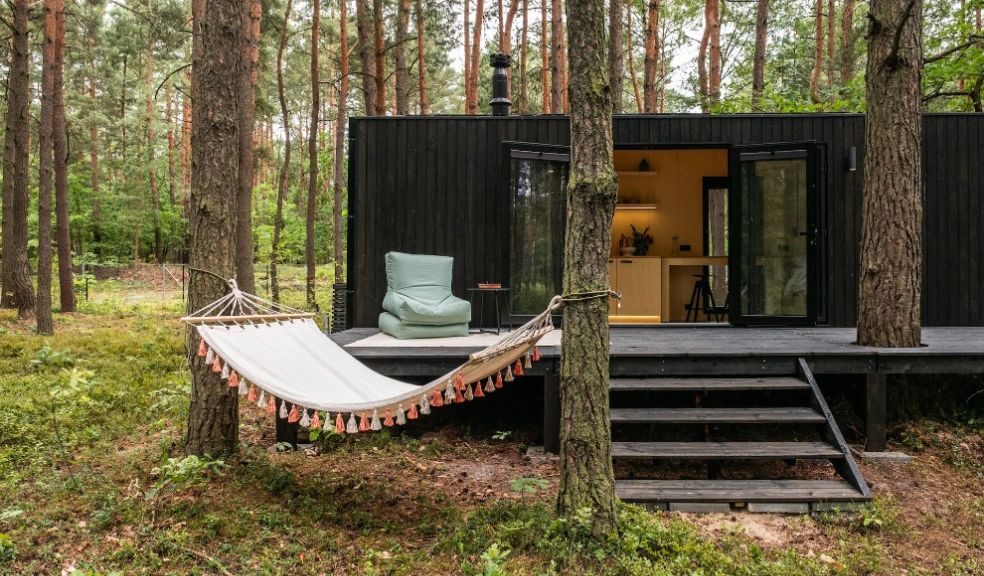
The two cabins are usefully different from one another. Bento One sits at the edge of a pond, with a lounger outside and a view across the water that catches the light first thing in the morning. Bento Two is buried deeper among the pines, with its own hammock strung between two trunks and an independent driveway. Each has its own entry code, sent the day before arrival, which means guests can come and go without ever crossing paths with anyone else. The site is adults-only.
The surroundings are quietly excellent. A nature reserve sits about five kilometres away, the Świder river runs nearby, and the wider Kampinos National Park – one of the largest stretches of protected forest in central Europe – is within easy reach for a day's walking or cycling. Local hosts mention encounters with moose and roe deer on the surrounding paths often enough that it does not sound like marketing copy.
What makes Bento Houses interesting beyond the obvious peace and quiet is the build quality. The cabins do not feel like rustic huts or summer-only shelters. They feel like small, fully resolved homes that happen to be in the woods – warm in winter, cool in summer, and detailed in a way that suggests someone has thought hard about the difference between a holiday let and a place where you might actually want to live for a week.
A note on the architecture behind the cabins
That impression is not an accident. The Bento Houses cabins are based on mobile houses by REDUKT Tiny Houses, a Polish studio that designs all-season tiny houses for both private use and small hospitality projects. Its approach sits closer to micro-architecture than to caravans: steel-and-timber construction, proper insulation, large panes of glass and a minimalist interior that lets the surroundings stay in the foreground. It is the reason Bento Two can sit out a Polish winter and still feel like somewhere you would happily spend a January weekend.
It is also a reminder that the appeal of these cabins is not really about the small footprint. It is about what a small footprint forces a good designer to do – choose materials carefully, place windows precisely, and remove everything that is not earning its place.
When a stay turns into an idea
Not every guest who books a cabin walks away with anything more than rested legs and a camera roll full of trees. But a small proportion of them start asking different questions on the drive home. What would it cost to put one of these on a piece of family land? Could it work as a second home, a weekend escape, or as the basis for a very small rental business?
These conversations are increasingly common, especially among people who already own a plot of woodland, a corner of a farm, or a piece of land near a lake. The appeal is partly financial – well-run cabin sites tend to enjoy strong shoulder-season bookings – and partly about lifestyle. A single, well-built tiny house lets owners use it themselves for much of the year and rent it out the rest, without committing to the scale and complexity of a guesthouse.
The reality is more demanding than the dream, of course. Planning rules vary widely across Europe, and the apparent simplicity of a "mobile" structure does not always translate into a quick permit. Seasonality is real: a beautiful site on a Polish lake will not generate the same income in February as in July. Maintenance, marketing, cleaning and guest communication all take time. None of this is a get-rich-quick scheme, and anyone promising otherwise should be treated with suspicion.
Working with an experienced manufacturer such as REDUKT can take some of the risk out of the build itself – proper insulation, a solid heating system and a well-resolved interior matter as much for owner-occupation as for guests. But the harder questions are local: planning rules, demand in the area, and whether you actually enjoy hosting people. The cabin is the easy part.
Practical tips for booking a tiny house in Europe
A few things worth knowing before booking.
For weekends in spring, summer and early autumn, book six to twelve weeks ahead. Popular sites near major cities – RAUS's locations around Berlin, Bento Houses outside Warsaw – sell out faster than you might expect, particularly for Friday and Saturday nights. Mid-week stays in March, April, October and November are usually easier to come by, often cheaper, and arguably better: lower light, fewer mosquitoes, more wood smoke.
Before clicking confirm, check three things. First, heating and insulation: a wood-burning stove is lovely, but only if there is also a thermostat-controlled system for when the fire goes out. Second, the photographs of the surroundings: a cabin's worth is mostly defined by what is outside its windows. Third, travel time from the nearest airport or station, particularly if you are arriving on a Friday evening and want dinner inside the cabin, not on a motorway.
A tiny house holiday is not for everyone. People who like room service, sea-view balconies and the buzz of a hotel lobby will be happier elsewhere. But for couples, solo travellers and small groups of friends who want a few days of quiet, good design and a forest at the door, the format has quietly become one of the more interesting things happening in European travel. Slower, smaller, closer to the ground – and, increasingly, the kind of holiday that travellers want to repeat.