








How to plan the perfect European road trip without the stress
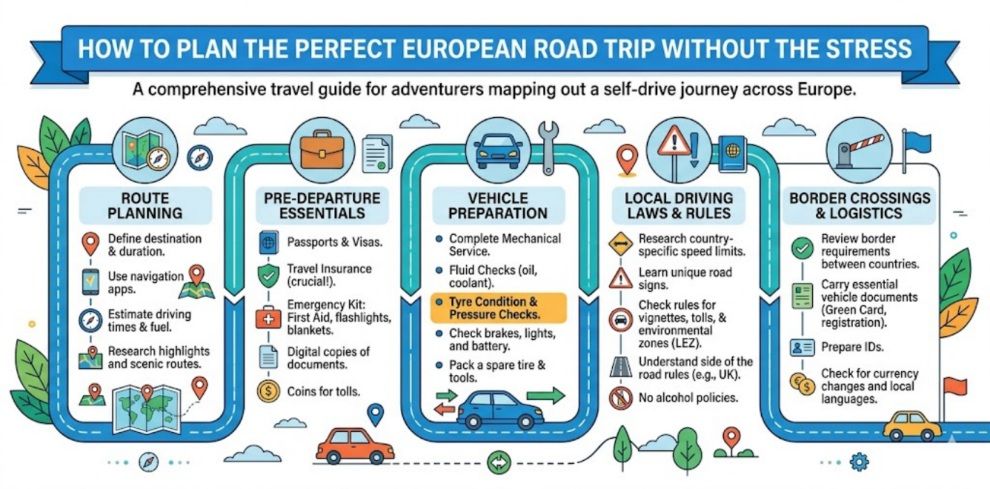
A self-drive journey across Europe is one of the most rewarding ways to travel. You set the pace, choose the stops, and discover places no guided tour ever reaches. But without the right preparation, a dream trip can quickly become a headache. Here is a practical, no-nonsense guide to planning a smooth European road trip — from mapping your route to checking your tyres before you leave the driveway.
1. Plan Your Route with Flexibility in Mind
Start with a rough outline, not a rigid schedule. Decide on a few key destinations and leave room for detours. Tools like Google Maps, Roadtrippers, and ViaMichelin are all useful for plotting distances and estimating drive times.
A good rule of thumb: keep daily driving under three to four hours. Longer days behind the wheel lead to fatigue, missed scenery, and a stressful trip overall. Build in buffer days for weather delays, unexpected stops, or simply enjoying a place more than expected.
2. Understand Driving Laws Across Borders
Traffic rules vary significantly between European countries. What is optional in one nation may be legally required in another. The table below gives a quick overview of key rules in popular road trip destinations:
|
Country |
Speed Limit (Motorway) |
Min Tyre Tread Depth |
Key Requirement |
|
Germany |
130 km/h (advisory) |
1.6 mm |
Winter tyres in winter conditions |
|
France |
130 km/h |
1.6 mm |
Hi-vis vest & warning triangle |
|
Italy |
130 km/h |
1.6 mm |
Hi-vis vest mandatory |
|
Spain |
120 km/h |
1.6 mm |
Spare tyre or repair kit |
|
Austria |
130 km/h |
3 mm (winter) |
Winter tyres Nov–Apr in some areas |
Always carry your driving licence, vehicle registration document, proof of insurance (Green Card), and a valid passport or ID. Many countries also require a warning triangle and a reflective jacket — keep them accessible, not locked in the boot.
3. Crossing Borders: What to Know
Most EU and Schengen countries have open borders with no passport checks. However, keep your documents ready at all times — spot checks do happen, and non-EU travellers will pass through formal border controls.
If you are renting a car, check with the rental company whether cross-border travel is allowed. Some providers restrict which countries a vehicle can enter, and driving outside permitted zones can void your insurance coverage.
4. Prepare Your Vehicle — Starting with the Tyres
Vehicle preparation is the most overlooked part of road trip planning. A breakdown in rural France or the Austrian Alps is not just inconvenient — it can be dangerous.
Before you depart, run through these checks:
- Tyre tread depth — EU legal minimum is 1.6 mm, but 3 mm or more is strongly recommended for long-distance travel
- Tyre pressure — check when cold, using the values in your vehicle manual or door jamb sticker
- Tyre condition — look for cracks, bulges, or uneven wear patterns
- Engine oil, coolant, brake fluid, and windscreen wash levels
- Brake pad condition and all lights functioning
- Spare tyre or puncture repair kit in good condition
If your tyres are due for a replacement before a long trip, it is worth investing in quality. Platforms like AUTODOC.co.uk offer a wide range of tyres at competitive prices, making it easy to find the right fit for your vehicle before you set off.
5. Travel Insurance and Emergency Kit Essentials
European breakdown cover is separate from standard car insurance. Check whether your existing policy includes roadside assistance abroad, or take out dedicated European breakdown cover before you travel.
Pack a basic emergency kit: first aid supplies, a torch, jump leads or a portable battery booster, a phone charger, water, and a paper map of your route. Mobile signal is not guaranteed in mountain regions or rural areas.
Expert Tyre Advice for Mixed-Road Travel
If your route includes both motorways and more challenging terrain, tyre choice matters more than many drivers realise. According to our AUTODOC experts, our top all-terrain tyres for road use in 2026 include the Falken Wildpeak AT3WA, Michelin LTX A/T 2, General Tire Grabber AT3, Continental CrossContact ATR XL, and Goodyear Wrangler All-Terrain Adventure. These tyres strike the right balance between driving comfort and genuine off-road capabilities, giving you a quiet ride on tarmac without losing grip on gravel, mud, or soft soil.
FAQ: European Road Trip Planning
Below are answers to the five most common questions from drivers planning a first European road trip.
▶ Do I need an International Driving Permit (IDP) for Europe?
For most EU countries, your standard UK or national driving licence is sufficient. However, if you plan to travel to countries outside the EU — such as Turkey or Morocco — an IDP is recommended. Always check the specific entry requirements for each country on your itinerary.
▶ What is the most common driving mistake tourists make in Europe?
Underestimating driving distances. Maps can look compact, but mountain roads, border crossings, and slower rural routes add significant time. Always check realistic travel times using a route planner, not just straight-line distances.
▶ Are there road tolls in Europe, and how do I pay them?
Yes — France, Italy, Spain, Austria, and several other countries charge motorway tolls. Payment methods vary: some accept cash and card, while others require a pre-purchased vignette (sticker). Austria, Switzerland, and the Czech Republic all use vignette systems. Research the countries on your route before departing.
▶ How often should I check tyre pressure during a long road trip?
Check tyre pressure at the start of every new country or roughly every 1,000 km — whichever comes first. Always check when the tyres are cold (before driving or after parking for at least two hours). Pressure changes with temperature, which is especially relevant when crossing between warmer and cooler climates.
▶ What should I do if I break down in another country?
Pull off the road safely, put on your hazard lights, and place your warning triangle behind the vehicle at the correct distance (usually 50–100 metres depending on road type). Call your breakdown cover provider immediately — keep the number saved offline. If you do not have European breakdown cover, contact the local emergency services (112 works across the EU).
Final Thought
A European road trip rewards those who prepare well. Sort your documents, check your vehicle, understand the local rules, and leave room for the unexpected. The open road will do the rest.